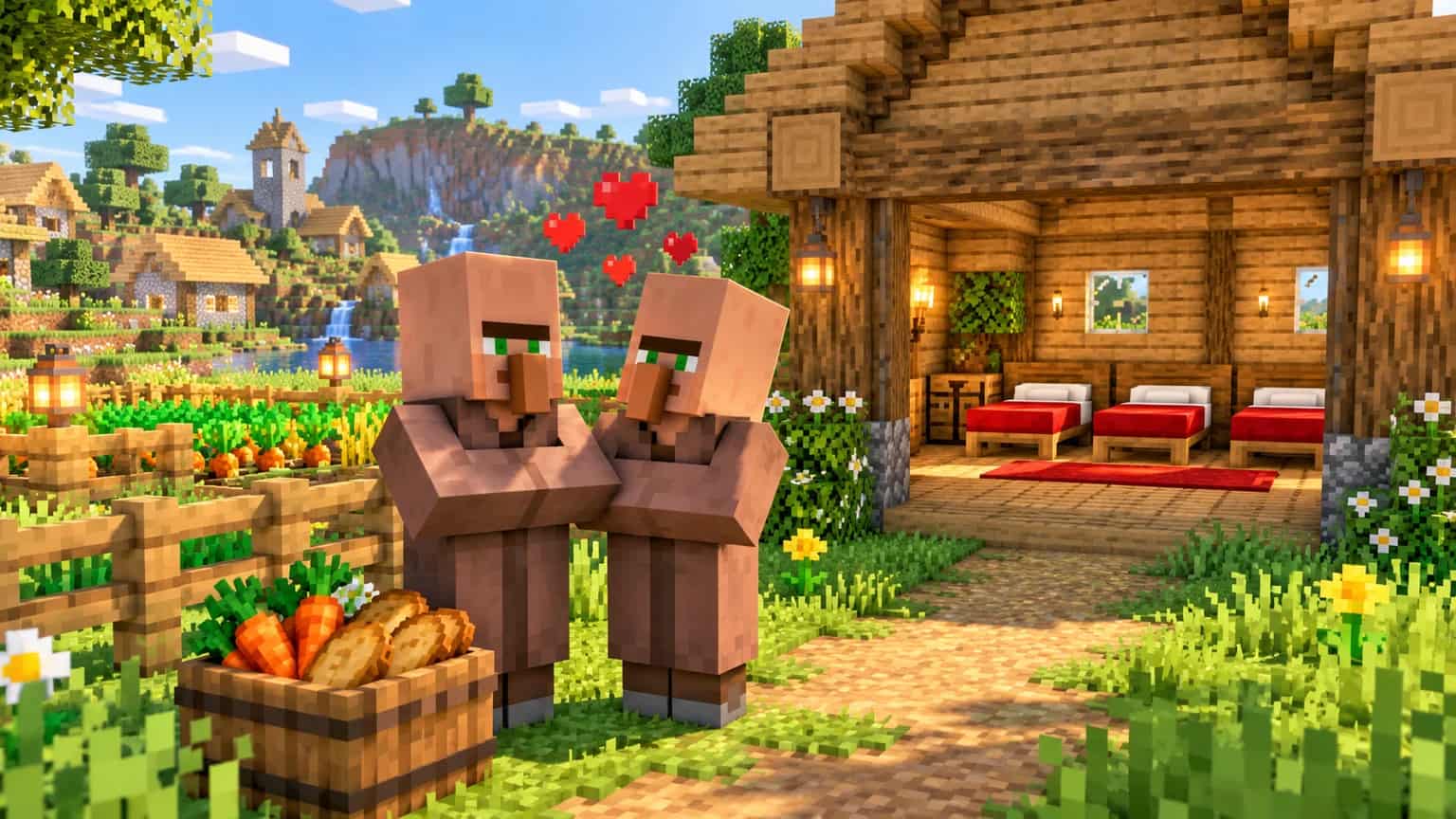



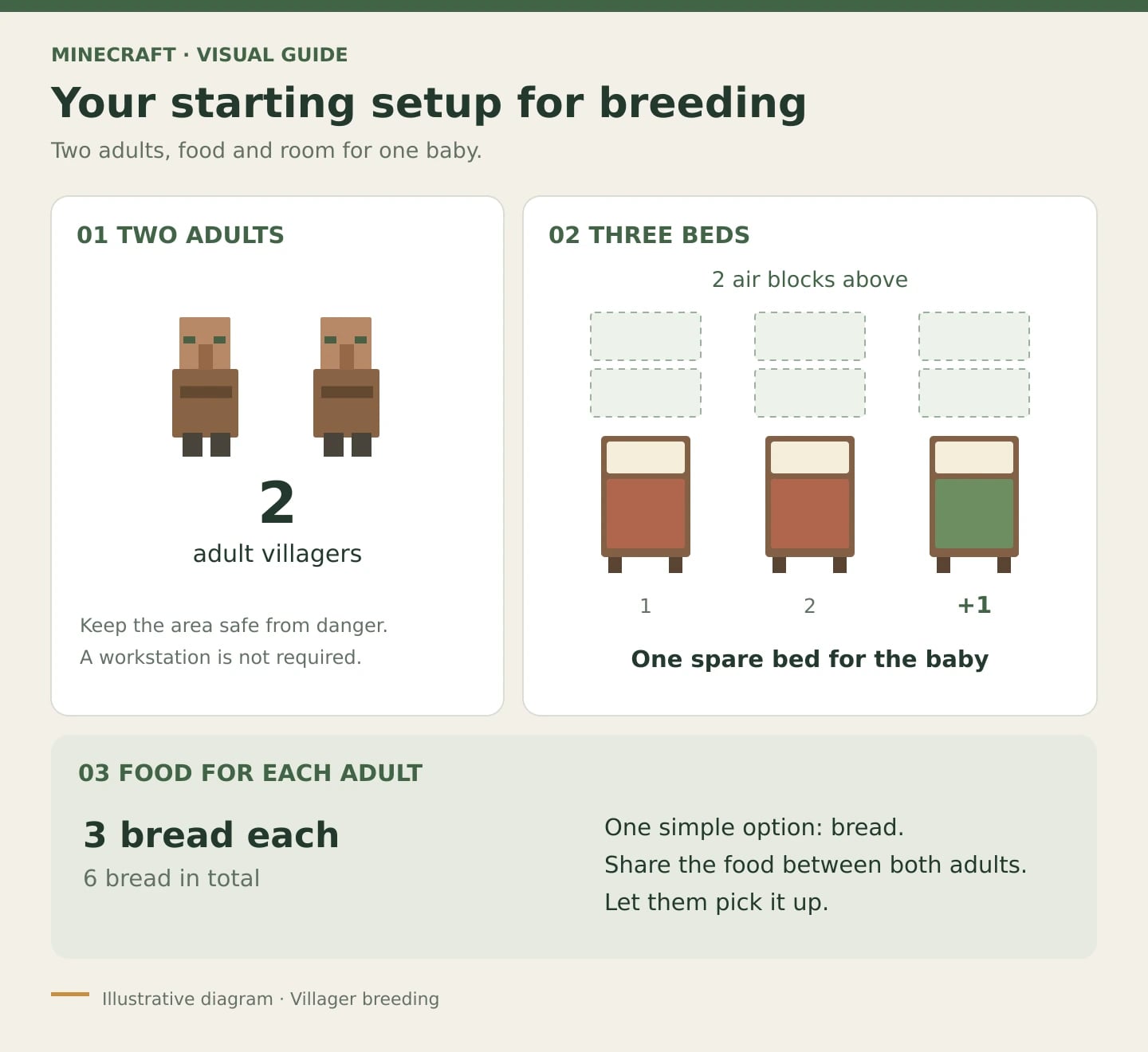
To breed villagers in Minecraft, bring together two adults, place three regular beds and give each villager 3 bread or 12 carrots, potatoes or beetroots. One bed must remain available for the baby. In Java, the game also needs to find a valid path to that bed. For a straightforward first setup, keep the route open and leave two full air blocks above the beds.
The food needs to reach both villagers’ inventories: drop it nearby and watch them pick it up. You do not need a breeding button, professions or rows of doors. This guide starts with a simple manual breeder, then explains Bedrock’s differences and why hearts sometimes appear without a baby.
Documentation reviewed October 10, 2026. Scope: vanilla Java and Bedrock mechanics, with edition differences identified. The illustrations are explanatory diagrams, not evidence of in-game testing. Add-ons, mods, plugins, experiments and older versions may change behavior.
What you need to breed villagers
- Two adult villagers: babies cannot breed yet. The adults can have different professions or be unemployed.
- Three regular beds for the first baby: two for the adults and one extra. Include any nearby villagers that might already be using these beds.
- Food for both adults: how you distribute it matters as much as the total.
- A safe, accessible space: protect it from enemies and do not separate the adults with blocks.
Job-site blocks assign professions; they are not a breeding requirement. A composter is useful if you later want a farmer to produce food, but you do not need one for the first attempt. You also do not need a bell or a naturally generated village.
How much food does each villager need?
| Food | Per adult | For the pair |
|---|---|---|
| Bread | 3 | 6 |
| Carrots | 12 | 24 |
| Raw potatoes | 12 | 24 |
| Beetroots | 12 | 24 |
These are alternatives: you do not have to provide every food in the table. Minecraft’s official bread article confirms that three loaves make a villager willing to breed. Bedrock’s vanilla villager definition also documents the food villagers collect and share.
For your first attempt, use one food type and hand out the portions separately. If you drop all six bread in one spot, one adult may collect more than the other. Food disappearing from the ground does not prove both have enough. Wheat and seeds do not directly replace the bread or vegetables in this list; craft bread before feeding a pair manually.
Build a manual villager breeder, step by step
1. Prepare the area before moving villagers
Choose level ground, light it up and build an enclosure where you can observe the villagers without escapes or attacks. Leave walking space between the adults and the beds. Start without water channels, drops, trapdoors or beds behind walls: adding them immediately makes problems harder to isolate.
If you are near a trading hall or iron farm, note where its villagers and beds are located. While learning, keeping this small breeder separate makes troubleshooting easier. There is no single separation distance that guarantees isolation for every layout in both editions.
2. Place the beds and check the ceiling
Use three complete, visible, regular beds. Leave two full layers of air blocks above the block layer occupied by the beds. The bed itself does not count as one of those layers, even though it looks shorter than a full block. Avoid a low slab ceiling immediately over the pillows while checking the setup.
In Java, an available bed needs a valid path; clearance above its head matters to that check. Clearing the whole bed and its approaches is practical advice that avoids overly tight layouts. Bedrock has its own village linking and population logic, explained below.
Build your village with friends
Give your next village a home in a shared world. Explore Teramont Minecraft hosting and choose the setup that fits your group.

3. Bring the adults together and distribute food
Use a transport method you are comfortable with, such as a minecart. Release both villagers inside the protected enclosure and let them approach each other. Drop one portion beside the first adult, wait for it to be collected, then repeat with the second. Keep the food near their feet rather than beyond a fence or inside moving water.
4. Watch the attempt
Stay nearby so the area continues to simulate. Hearts indicate an attempt; a baby appearing confirms success. If it is nighttime, let the villagers rest and observe them during the day. Avoid rebuilding everything after a few seconds, because that can interrupt bed assignments before you have checked the layout.
5. Make room for another baby
With two adults, one baby and three beds, the initial capacity is now occupied. To keep growing a small village, add useful beds as its population increases. Moving the baby into the next room does not guarantee it leaves the same village or releases a bed.
Java and Bedrock: the important differences
| Aspect | Java | Bedrock |
|---|---|---|
| Starting food | A portion for each adult. | The same basic bread and vegetable choices. |
| Beds | The game looks for an available bed with a valid path. | Recognized village beds and village population matter. |
| Moving babies | The breeder needs its capacity made available again. | A short move can still leave the baby within the village. |
| Profession | Not required for breeding. | Not required for breeding. |
| Automatic designs | Choose a design for your Java version. | Do not copy Java mechanisms without checking compatibility. |
In Bedrock, the game’s village is not simply a house or enclosure built by a player. Its inhabitants and points of interest connect through a dedicated system; Microsoft documents that system in the village dweller component. A wall can visually separate rooms without separating their links.
That is why it helps to begin with a pair, nearby beds and clear access. The diagram’s recommended clearance is a conservative layout choice; it does not mean both editions perform an identical pathfinding check.
Why will my villagers not breed?
They do not pick up food
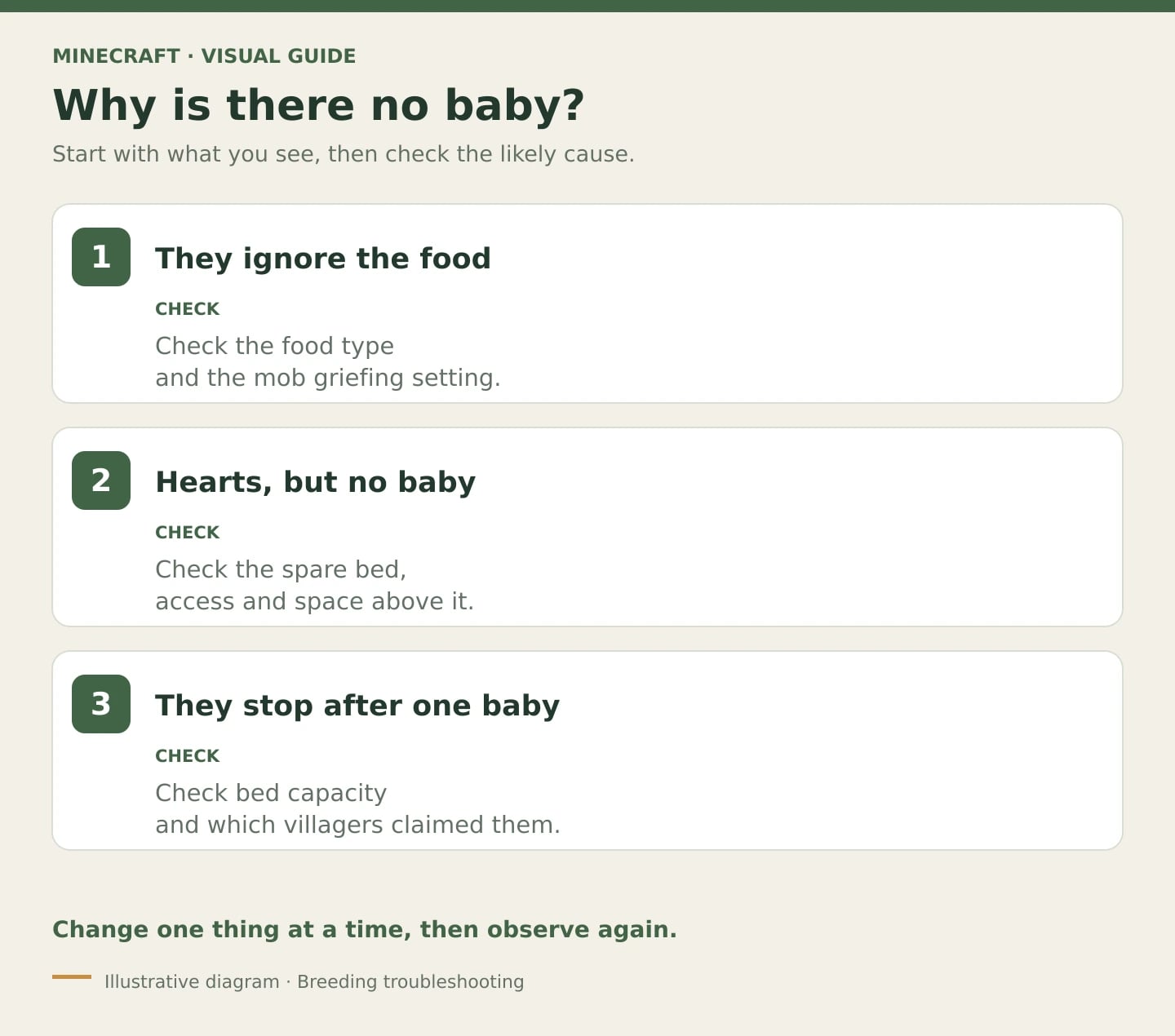
Check the item type and whether the villagers can reach it. If both ignore valid food, ask the administrator about the game rule controlling mob interaction with the world and any server protections. A full inventory can also prevent further pickups. Throwing down entire stacks does not distinguish between these causes.
Disabling the rule historically called mobGriefing can prevent villagers from collecting food. Mojang records this behavior in MC-177120. Do not enable it blindly: it also affects other mob interactions, including forms of environmental damage.
If you have permission, inspect the value without changing it: use /gamerule minecraft:mob_griefing in Java 1.21.11 and later; /gamerule mobGriefing in earlier Java; or /gamerule mobgriefing in Bedrock. Java’s naming changed in 1.21.11; Bedrock syntax is covered in its command documentation. You do not need to enable cheats to follow this guide’s normal gameplay steps.
They collect food, but there are no hearts
Check that both villagers are adults and that each received a portion. Keep them together, out of vehicles and away from threats. If they recently bred, allow time: Java has a cooldown of roughly five minutes of simulation before the same pair can produce another baby. A full inventory does not remove that wait.
Hearts turn into angry particles, with no baby
Start with the extra bed: is it available, is there clearance above it and, in Java, is there a valid route? Count nearby inhabitants instead of assuming there are only two. Clear obstacles before adding more food. Change one thing at a time so you can identify the cause.
One baby appeared, then the breeder stopped
Check remaining capacity, food and, in Java, the cooldown. In Bedrock, pay particular attention to whether a relocated baby still counts toward the same village. For a small group, adding a useful bed is often simpler than immediately engineering an automatic unlinking system.
It works in another world, but not on my server
Compare edition, version, game rules, plugins and add-ons. Try the minimal layout in a world copy before changing an important installation. Java 26.3 introduced the minecraft:villager_food component for defining villager food, so customized items can behave differently. This is documented in the official Java 26.3 release notes. A trading experiment should not be confused with the general breeding rules, either.
How long growth takes, and when to expand
A baby villager takes about 20 minutes of simulation to become an adult under normal rules. As a primary reference, Mojang’s published vanilla Bedrock definition gives its baby stage a duration of 1,200 seconds. Wall-clock time can be longer when the area is not being simulated or the server is running slowly; closing the world does not advance the process.
Before automating, confirm several births with the manual arrangement. Then add a farmer’s food supply and, separately, baby transportation. Plan a limit or a way to stop production: collecting villagers without a destination adds entities and unnecessary simulation work.
Once they grow up, organize their workstations. Read our guide to villager jobs and profession blocks before placing every workstation together.
Frequently asked questions
Can two unemployed villagers breed?
Yes. Employment is not a requirement. Nitwits can also breed even though they do not take a profession. The official Bedrock definition assigns breeding behavior to both nitwits and unemployed adults.
Do I have to trade with them first?
No trading is required for the food-and-beds method. A profession or trade does not fix a blocked bed or guarantee a baby.
Do I need doors, a bell or twenty beds?
Not to start a pair. Door-based explanations refer to older mechanics: Village & Pillage changed village detection. Keep iron-farm requirements separate from breeding requirements.
Can I use baked potatoes, seeds or any food?
For vanilla, use the four foods in the table. An item feeding a player does not mean it makes a villager willing to breed.
Does a pair produce one baby every five minutes?
That is not a guaranteed rate. Java’s cooldown is only one condition; food, beds, behavior and simulation still matter. Do not automatically apply that interval to Bedrock.
The most useful check: two adults, food distributed between them and real capacity for another inhabitant. Get that first baby before expanding. A breeder you understand is easier to maintain than a large one with a problem hidden among its mechanisms.