


Do you need to reboot your VPS for CVE-2026-99312? Not to fix the hypervisor. The flaw is in the physical server’s Linux kernel. It affects KVM on AMD when a guest can run another virtual machine inside it. In that setup, an administrator of their own VM could access host memory. TERAMONT confirms that it applied the patch and that, as of November 20, 2026, none of its nodes remain vulnerable to this CVE.
How a VM could reach memory outside its boundary
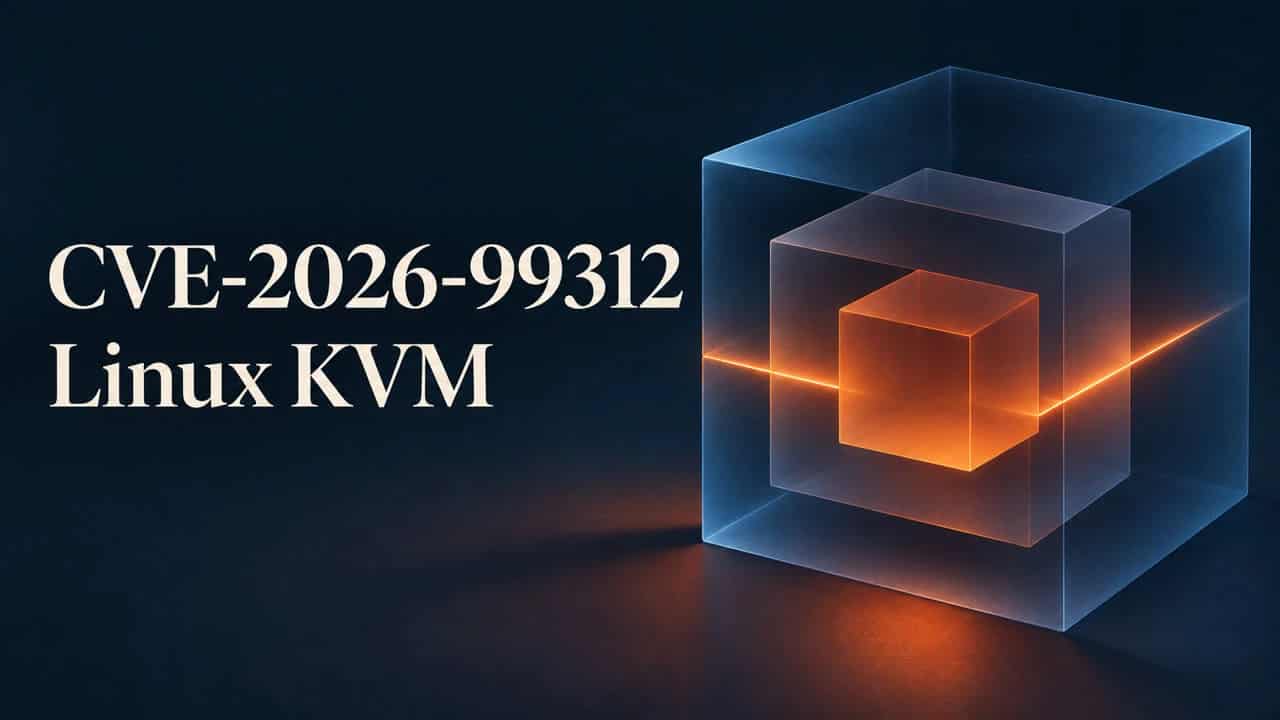
Consider two virtual servers sharing one physical machine. Each normally sees only its own memory because KVM translates addresses and enforces that boundary. When leaving a nested VM, KVM could retain a memory map that no longer belonged to the active guest. This could give a guest administrator access to host memory. Simply visiting a website on the VPS does not meet those conditions. CVE record · Red Hat’s scope assessment.

Looking for a VPS?
Compare TERAMONT plans and choose the resources your application needs.

What researchers demonstrated
DigitalOcean confirmed two separate findings by Terra Security: a read of approximately 127 GB of host RAM from a Droplet, and a 32-byte write on a dedicated AMD server with no other customers attached. These figures measure demonstrations, not victims. They do not mean that 127 GB of customer records were stolen. Neither test took place on TERAMONT infrastructure. The validating provider’s account.
Is my KVM host affected?
| Your setup | What to check |
|---|---|
| AMD KVM host with nested virtualization available to the guest | Check the running kernel and patch coverage. This is the configuration at issue. |
| Intel VMX host, or AMD host without nested virtualization available | The reported path requires nested AMD SVM. This is not a statement about other CVEs. |
| You administer only the guest OS on a VPS | Your guest kernel version does not identify the host kernel. Ask your provider; updating your application will not patch KVM. |
Which Linux kernels fix CVE-2026-99312?
The Linux kernel team’s November 18 notice lists 6.12.118, 6.18.64 and 7.3.5 as fixed stable releases on their respective branches. The fix also appears in 7.4-rc2; you do not need to deploy a release candidate to production. Distribution builds may carry a backport under a different version. Linux kernel release advisory.
Debian: when checked on November 20, the tracker listed the Bookworm security package 6.1.192-2 and the Trixie security package 6.12.117-1 as vulnerable, and Sid 7.3.5-1 as fixed. That is not a reason to switch a stable server to Sid; check your current Debian branch. Ubuntu: match the release and kernel flavour in Canonical’s CVE tracker. A generic package entry does not establish the state of a cloud kernel or an in-memory fix.
What host operators can check and what TERAMONT did
On an AMD host you administer, these two checks are read-only:
uname -r
cat /sys/module/kvm_amd/parameters/nested
Y or 1 means the module allows nesting; it does not prove a particular guest is exposed or that an attack occurred. A missing file is not proof of a patch. Compare the running kernel with your vendor’s advisory, or verify that an active live patch explicitly covers this CVE. If patching must wait, restricting nested virtualization closes the reported path, but affects workloads that require nesting. Coordinate the change with their owners.
TERAMONT has applied the patch across all its nodes. You do not need to reboot your VPS to complete this host-side correction. Keep updating your own guest OS as usual. See how TERAMONT live-patches its hypervisor kernels.