




Cloudflare announced Vinext 1.0 on September 28, 2026. It brings Next.js APIs to Vite. The useful question is not whether it “kills Next.js,” but whether your application benefits from switching toolchains—and what you must verify first.
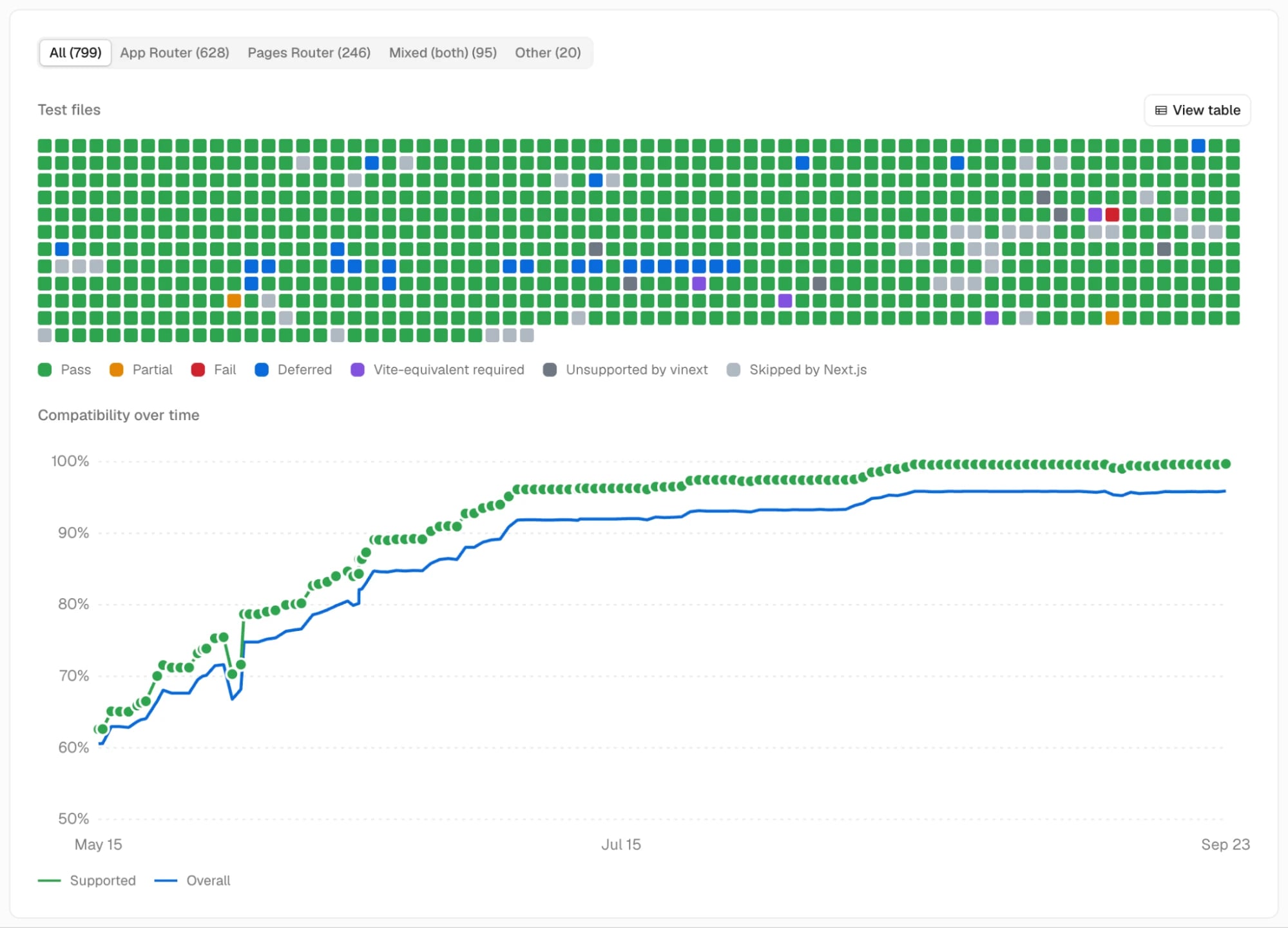
The official announcement reports test compatibility above 99%, excluding Cache Components. That does not mean 99% of applications migrate unchanged. We reviewed documentation and public results on September 28; these figures are not our own benchmark.
What Vinext is and what changes
Vinext is an alternative implementation, not a hosting service or an official Next.js update. Its documentation describes retaining familiar routes and components while Vite handles development and builds. It supports App Router, Pages Router, server rendering and static generation.
Separate three decisions: how you write your application, how you build it and where it runs. Changing the second does not automatically require changing the third.
Prefer Node.js on a server you control?
Explore Teramont VPS Hosting to evaluate your application and control its environment. Validate compatibility and resources, and plan backups, security and maintenance.

Vinext vs Next.js: what current benchmarks show
The project's performance dashboard, September 28 run at commit 62125e1, reports these results from five rounds. They are the project's measurements of its test scenario, not a representative sample of all applications:
| Metric | Next.js / Turbopack | Vinext / Vite 8 |
|---|---|---|
| Development server cold start, median | 2.60 s | 3.50 s |
| Production build, median | 4.58 s | 4.01 s |
| Gzipped client bundle | 185.6 KB | 143.4 KB |
In this run, Next.js starts sooner and Vinext builds sooner. Neither timing directly measures how long a visitor waits for your website. Nor does it prove a particular hosting saving: your traffic, caching, queries and dependencies are missing from the comparison.
Compatibility: three areas worth checking
- Advanced caching: Cache Components and Partial Prerendering remain incomplete.
- Images and fonts: build-time processing does not reproduce the entire Next.js pipeline.
- Build configuration: webpack plugins do not automatically carry over to Vite.
These boundaries appear in the official differences reference. If one is essential to your project, resolve it before comparing speed. A working home page does not prove checkout, authentication or cache invalidation works correctly.
How to test migration without changing production
Use a copy or evaluation branch with development credentials. The migration guide recommends scanning your project before initializing Vinext. The first line labels the language: do not paste bash into your terminal.
npx vinext check
npx vinext init
Inspect the check results first. init installs dependencies and adds configuration and parallel scripts; select Node or Cloudflare for your evaluation target. These commands execute packages: review the downloaded version and keep the dependency lockfile so the evaluation is repeatable.
Suggested store example, not an executed test: cover five journeys: opening a product, signing in, adding it to the cart, paying in test mode and updating stock. Repeat with your current implementation and Vinext. Check errors, served content, permissions and whether updates appear without exposing another session's data.
Cloudflare Workers or a VPS?
| Your need | What to evaluate |
|---|---|
| You already use Workers services | Vinext’s native integration; test bindings and runtime limits. |
| You want control of a Node.js process | Standalone output on a VPS; take responsibility for operations. |
| Your current Next.js app works without a measured problem | Keeping it is also a valid decision. |
Vinext documents standalone Node.js output. This makes a VPS an option to evaluate, but does not automatically move Workers-specific services to Node. And Next.js already supports self-hosting: you do not need Vinext solely to leave Vercel.
Our recommendation
Try Vinext for a specific reason: integrating Vite, using Workers or addressing a measurable development bottleneck. Keep Next.js when a change introduces risk without a demonstrated benefit. Before deciding, compare the same application with pinned dependencies and equivalent conditions; record multiple runs, not just the fastest.
Does migration automatically improve SEO?
No. Verify URLs, metadata, rendered content, redirects and status codes remain correct. A shorter build helps the team; it does not guarantee better search rankings.
Does version 1.0 remove the need for testing?
No. Your critical features and actual deployment environment determine readiness. An overall compatibility percentage helps guide evaluation, but it cannot replace your acceptance tests.