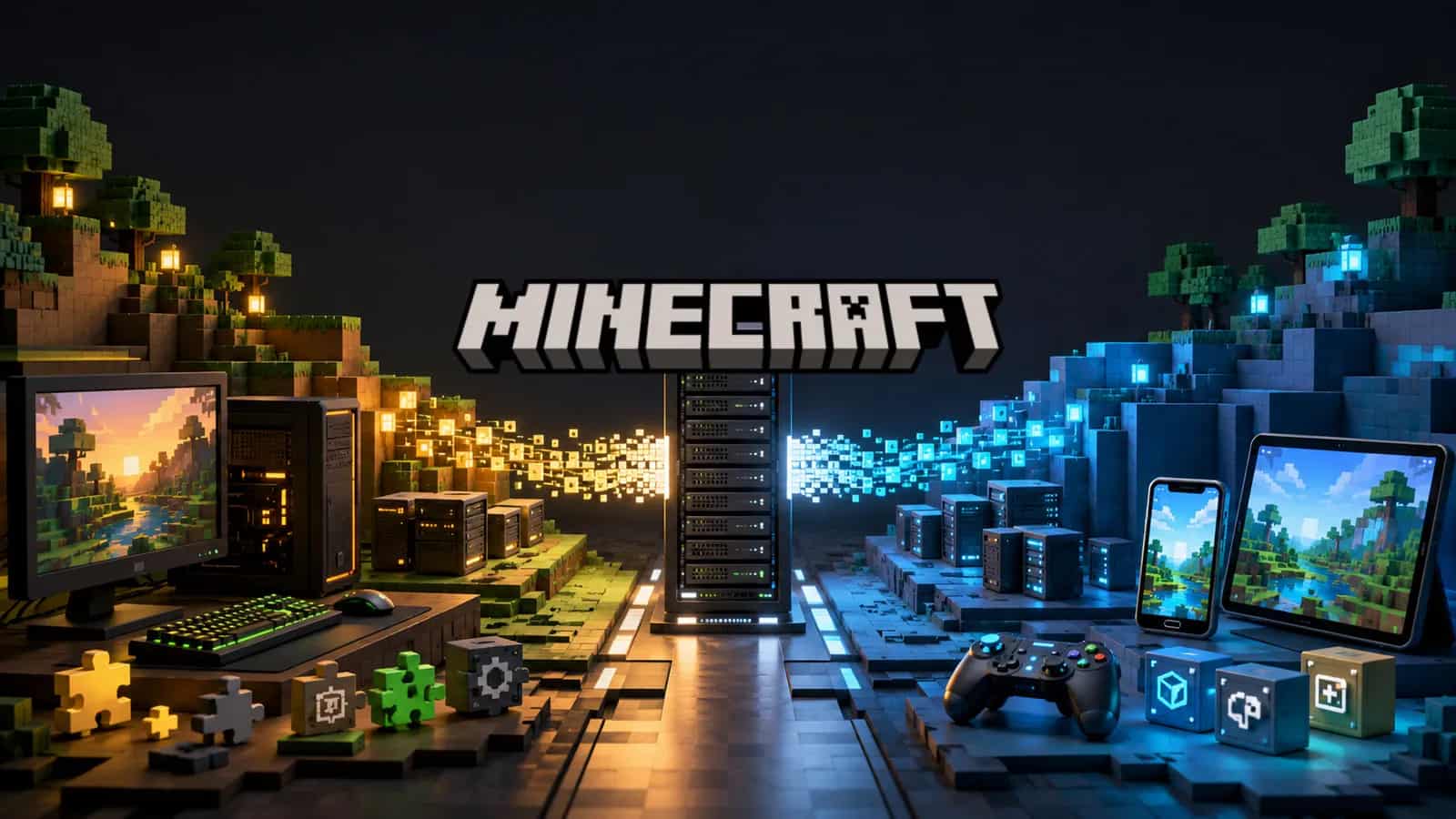




Minecraft Java is usually the better server choice when you want flexible plugins, mods, Paper or Velocity, and deeper technical control; Bedrock is usually the practical choice when console, mobile, and Windows Bedrock players come first. For a group split across editions, a Java server with Geyser is the common starting architecture, but the bridge is not perfect compatibility and it does not turn a Bedrock server into Java. Neither edition wins every use case.
How to read this comparison: a documented fact is supported by Mojang, Microsoft, Paper, or Geyser; a recommendation is conditional editorial guidance; and an operational inference is a likely consequence that still needs validation against your versions, devices, and workload. Keeping those labels separate prevents a preference from becoming a fake specification.
Minecraft Java vs. Bedrock decision table
| Decision point | Java Edition | Bedrock Edition | What should drive the choice |
|---|---|---|---|
| Clients | Java players on Windows, macOS, and Linux | Bedrock players on compatible devices, including mobile, console, and Windows | Inventory the installed edition, not just the hardware |
| Server stack | Official server, Paper, and other Java projects or mod loaders | Bedrock Dedicated Server with add-ons and scripting | Start from the software your content requires |
| Extensions | Plugins, mods, and modpacks with distinct requirements | Add-ons, behavior/resource packs, and scripting APIs | Do not assume a one-to-one equivalent across editions |
| Native crossplay | Among compatible Java clients | Among compatible Bedrock clients | The editions do not natively share servers |
| Mixed group | Can accept Bedrock clients through Geyser, with limits | Does not become a Java server through Geyser | Validate sign-in, mechanics, packs, and plugins first |
| Operations | Java runtime, server JAR, configuration, and stack updates | BDS binary, properties, packs, scripts, and compatible updates | Use the model your administrator can maintain reliably |
Documented fact: Mojang describes crossplay among Java players on Windows, macOS, and Linux, and among Bedrock players on compatible devices. Its guide to Bedrock and Java differences treats them as separate editions. PC access may include both, but owning the two Minecraft editions does not merge their clients, servers, worlds, or content.
Choose for the players before choosing the server
The most useful question is not “which edition is best?” It is “which edition can every person launch?” Ask players to check whether their title screen says Java Edition or Bedrock, which device they will use, and whether changing clients is realistic. “I play on PC” is incomplete: a Windows player may have access to both editions, while macOS and Linux belong on the Java side of Mojang's comparison.
Recommendation: when everyone already plays Java on a computer and the roadmap depends on plugins, mods, or a modpack, assess Java first. When core members play on phones, tablets, or consoles, Bedrock usually avoids asking them to adopt another client. Families, schools, and managed-device groups should also check account controls, platform permissions, and the allowed connection workflow before buying hosting.
Be especially careful with third-party servers on consoles. Account controls, platform rules, and join interfaces are not uniform across every device, and available methods can change. Do not assume every console can add or open an arbitrary server address the way a PC or phone can. Verify the exact models, accounts, and current versions your group will use.
Client edition, server software, and crossplay are separate layers
Java servers: Vanilla, Paper, plugins, and loaders
Documented fact: Mojang distributes the official Minecraft Java server, which needs a compatible Java runtime. Paper is Java server software, and the official Paper documentation covers its setup, configuration, and maintenance. Paper supports plugins, but its guide notes that plugins have broad server access. Use trusted sources and check compatibility before following the steps for adding Paper plugins.
Vanilla, Paper, a proxy such as Velocity, and a mod loader solve different problems. Paper does not automatically make a client-side or loader mod behave like a plugin. A modpack may require an exact loader, game version, and file set on the server, the clients, or both. Use our guide to Minecraft server plugins to explore server features and our overview of Minecraft modpacks to compare experiences, then verify the documentation for the release you intend to run.
Bedrock Dedicated Server: properties, add-ons, and scripting
Documented fact: Mojang provides Bedrock Dedicated Server for the Windows and Ubuntu/Linux environments listed as supported on its current page. Microsoft documents how to get Bedrock Dedicated Server running and maintains a reference for server.properties. Check those pages at deployment time because supported systems, releases, and settings evolve.
“Bedrock has no mods” is an inaccurate shortcut. Bedrock uses add-ons, behavior packs, resource packs, and scripting APIs. Those tools have a different authoring and deployment model from Paper plugins or Java mod loaders. Operational inference: if one extension is central to the community, its availability and maintenance status matter more than a broad claim about which ecosystem has more options.
Mixed editions: Geyser bridges Bedrock clients to Java
Documented fact: Geyser lets Bedrock clients connect to a Java server. The direction is Bedrock to Java; it neither converts BDS into Java nor lets a Java client join a Bedrock server. Geyser's official FAQ documents limitations and edition differences that may affect features and play.
Recommendation: treat Geyser as an access layer that needs acceptance testing. Exercise sign-in, inventories, commands, plugin menus, resource packs, skins, and the mechanics your community cares about. Do not promise identical redstone behavior or complete translation of protocols and content. Follow our dedicated guide to installing GeyserMC and Floodgate rather than duplicating its setup steps here.
Choose hosting for your community's edition
Compare Minecraft Hosting options for Java, Bedrock, or crossplay based on your players and server management needs.
Plugins, mods, modpacks, and add-ons are not interchangeable
- Paper plugin: extends a compatible Java server through its API. It may not require a client mod, but compatibility and trust still need review.
- Mod: changes Java through a specific loader. Some are client-only, some server-only, and some must match on both sides.
- Modpack: combines mods, configuration, and dependencies. The exact pack release matters more than the generic label “modded.”
- Bedrock add-on: packages resources and behavior for Bedrock. Scripting can extend it, but it does not reproduce Java plugin APIs automatically.
Recommendation: list the five features the project cannot lose—perhaps economy, moderation, a map, pack content, or classroom automation—and identify a maintained implementation in each candidate ecosystem. A single hard dependency can reasonably outweigh a dozen general advantages.
Performance depends on workload, not the edition label
No universal benchmark supports saying that Java or Bedrock always uses less RAM, consumes less CPU, or supports more players. Version, server software, world state, concurrency, chunk generation, entities, simulation distance, plugins, mods, add-ons, and scripts all reshape the workload. A nearly empty test world cannot establish capacity for a live community.
Operational inference: an ecosystem that requires more content or protocol translation may shift a bottleneck, but both the direction and size of that effect need measurement. Define a credible concurrent peak and a representative session—exploration, farms, extra worlds, backups, and scheduled tasks—then observe total memory, CPU, tick time, storage, and network separately.
Simulation distance and world generation can raise load without providing a fixed conversion to gigabytes or CPU cores. A crossplay bridge adds components that need updates and monitoring, but that is not evidence for an invented percentage penalty. Decide on functional compatibility first, then size and tune the actual deployment.
Six common server scenarios
| Scenario | Good starting point | Validate before committing |
|---|---|---|
| PC friends who already use Java | Java, particularly if the server may expand later | Shared version, software stack, extensions, and update ownership |
| Console and mobile group | Bedrock usually minimizes client changes | Third-party server joining on each console, accounts, and controls |
| Public plugin-driven SMP | Java with Paper is often the most direct fit | Plugin compatibility and trust, moderation, and upgrade plan |
| Community built around a modpack | Java with the loader and version required by the pack | Client/server files, licenses, memory, and update procedure |
| Family or school server | The edition already available and manageable on its devices | Privacy, allowlists, permissions, purchases, backups, and adult support |
| Mixed Java and Bedrock community | Java plus Geyser as a candidate, not a guarantee | Console workflow, authentication, mechanics, packs, plugins, and rollback |
These rows are recommendations, not universal facts. A console-heavy group may still choose Java with Geyser because an established Java community is worth the tradeoffs; a PC group may simply prefer Bedrock. The right architecture satisfies the hard requirements without creating an operations model the team cannot sustain.
Administration, security, and updates apply to both
Java adds responsibility for the runtime, server JAR, and any proxy, loader, or plugin. BDS administrators maintain its binary, properties, packs, and scripts. Both options still need access control, log review, tested updates, backups outside the live instance, and proof that a restore works. The edition changes the toolchain; it does not remove operational ownership.
Install extensions from sources you trust, minimize permissions, protect credentials, maintain a staging copy, and schedule updates deliberately. Public or monetized communities should review the current Minecraft EULA and the Usage Guidelines linked from it. A technically possible configuration is not, by itself, permission to use or monetize content in a particular way.
Moving between Java and Bedrock
Fact: world formats, packs, commands, and mechanics differ between the editions. Recommendation: approach any third-party world converter as a potentially lossy migration, never as guaranteed portability.
- Freeze the scope. Record the edition, version, seed, dimensions, plugins or add-ons, commands, packs, permissions, and player data that matter.
- Make a verifiable backup. Keep the original instance untouched and prove you can restore it.
- Convert only a copy. Use a third-party tool only when it supports the versions involved; retain its log and never overwrite the source.
- Test with real players. Inspect spawn, borders and chunks, inventories, containers, entities, redstone, commands, packs, and respawn points.
- Plan cutover and rollback. Explain possible losses, limit writes during the switch, and return to the original when agreed acceptance criteria fail.
A world opening without an error is not proof of complete equivalence. Visit representative regions and compare the functions that define the community before calling the migration complete.
Minecraft Hosting pre-purchase checklist
- Which edition and version is installed for every player, and on which device?
- Can the community change clients, or is its current edition non-negotiable?
- Do you need Vanilla, Paper, a proxy, a loader/modpack, or Bedrock Dedicated Server?
- Which plugins, mods, add-ons, scripts, or packs are essential, and who maintains them?
- Is crossplay mandatory, and has Geyser passed tests for the critical features?
- Can every console complete the intended join flow with its current accounts?
- What is a credible concurrency peak, and what will players do during it?
- How will worlds, new chunks, entities, simulation distance, and background jobs affect load?
- Who owns updates, and how will they be tested before production?
- Where are backups stored, how long are they retained, and how will restores be tested?
- Is there a staging copy and rollback plan for crossplay, extensions, and migrations?
- Do the server and its content follow the current EULA and usage terms?
With those answers, you can compare Minecraft Hosting options without assuming unconfirmed pricing, resources, slots, or features. The durable conclusion is simple: Java favors technical control and plugin/mod ecosystems; Bedrock favors reach across Bedrock devices; a mixed community should test Java plus Geyser as a conditional architecture, not promise full compatibility.