


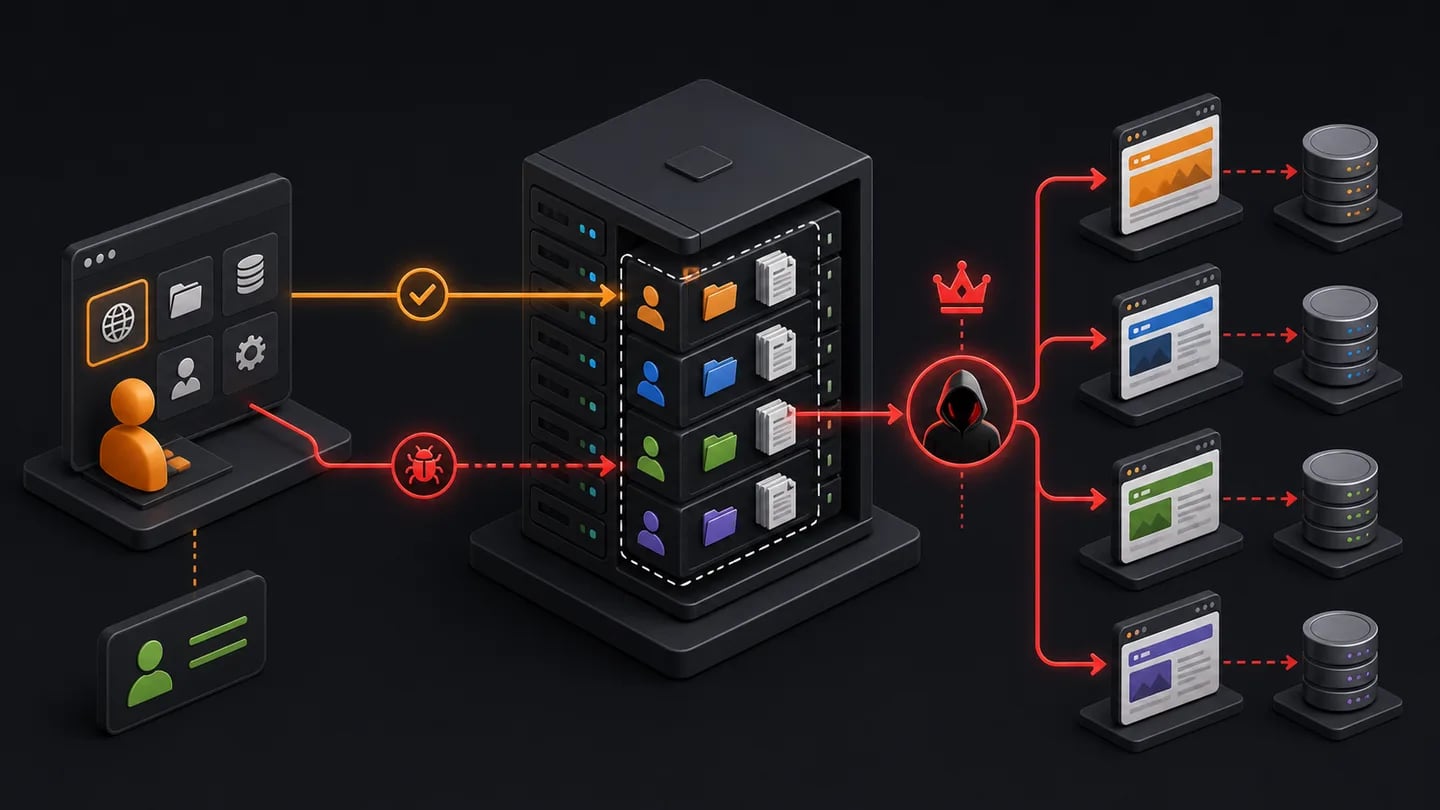
CVE-2026-65643 is a critical cPanel & WHM vulnerability that can let an authenticated hosting user escalate to code execution as root. The attacker needs a cPanel account allowed to add parked or addon domains; this is not unauthenticated Internet RCE. On a shared server, however, one compromised account can put every website, database, and secret on the machine at risk.
Do this now: update cPanel to a fixed build, verify the version actually running, and investigate the server if an unknown or compromised account could manage domains before the update.
| Fact | Confirmed value |
|---|---|
| ID | CVE-2026-65643 |
| Required access | Authenticated cPanel account able to add parked or addon domains |
| Impact | Arbitrary file creation and code execution as root |
| Potential scope | Every account, site, and database on the affected server |
| Fix | Install a patched build or later |
Why the impact is severe
cPanel says the vulnerable domain-parking functionality can let an eligible account holder create arbitrary files. Once that operation crosses the boundary between a tenant and the operating system, it can become root code execution. Root can read or change other customers' files, secrets and services, making this especially serious for resellers and agencies that consolidate many clients.
Affected and fixed builds
The advisory covers all supported versions before the fixed build for their branch.
| Branch | First fixed build |
|---|---|
| 11.110 | 11.110.0.141 |
| 11.134 | 11.134.0.53 |
| 11.136 | 11.136.0.37 |
| 11.138 | 11.138.0.2 |
| WP Squared | 11.138.1.7 |
An end-of-life branch is not safe merely because it is absent. Move it to a supported release.
How to check and update
Isolate your projects on a VPS you control
Run your sites with root access, defined resources, snapshots, and the freedom to apply urgent security updates.

/usr/local/cpanel/cpanel -V
/scripts/upcp --force
/usr/local/cpanel/cpanel -V
You can also use WHM → cPanel → Upgrade to Latest Version. Confirm the final build is at or above the fixed value for the branch. Automatic updates are useful, but still verify completion.
Exposure versus compromise
A server was exposed when it ran a vulnerable build and had at least one account with the required domain permission. Exposure does not prove compromise. Logs and artifacts are needed to establish whether abuse occurred.
Initial investigation
Preserve a snapshot before cleanup if intrusion is suspected. These commands are triage, not a complete forensic examination:
sudo less /usr/local/cpanel/logs/login_log
sudo less /usr/local/cpanel/logs/access_log
sudo less /usr/local/cpanel/logs/error_log
sudo find /home -xdev -type f -mtime -3 -printf '%TY-%Tm-%Td %TT %u %p\n' | sort
awk -F: '$3 == 0 {print $1, $6, $7}' /etc/passwd
sudo ls -la /etc/cron.d /etc/cron.daily /var/spool/cron
Look for unknown domains, unexpected ownership, new SSH keys, cron jobs, services, UID 0 users, and changes outside maintenance windows. Rotate credentials from a clean device. When persistence is found, rebuilding from trusted media is usually safer than deleting isolated files.
Defense beyond the patch
- Remove domain-management privileges from plans that do not need them.
- Protect WHM and SSH with MFA, access restrictions, and unique credentials.
- Separate critical or high-risk tenants onto different VPS instances.
- Maintain external backups and test restoration.
- Alert on new domains, users, keys, and scheduled tasks.
- Do not treat CloudLinux, CageFS, or a WAF as a replacement for the update.
Frequently asked questions
Can it be exploited without a cPanel account?
The official advisory requires an authenticated account with permission to add parked or addon domains. Stolen credentials and malicious tenants remain realistic scenarios.
Does it affect WordPress only?
No. The flaw is in cPanel. Root compromise can affect any application on the host.
Does updating remove a backdoor?
No. Updating closes the flaw but does not undo earlier changes. Investigate and recover from a trusted state when indicators exist.
Conclusion
CVE-2026-65643 breaks a central shared-hosting boundary. Verify the exact build, patch, preserve evidence when needed, and review the entire host. cPanel can remain part of a sound stack, but the panel, operating system, tenant isolation, and monitoring all need independent care.